Flight Case Corners protect the weakest points of transport cases: the exposed edges. A poorly fitted corner can loosen after repeated loading, vibration, and rough warehouse handling. This guide examines 10 best Flight Case Corners for global buyers, focusing on practical performance rather than appearance alone.
Industry reports support this focus. Grand View Research identifies protective packaging as a growing market, driven by reusable transport systems and higher-value equipment. MarketsandMarkets also highlights durable, customized packaging as an important trend across logistics and industrial supply chains. These reports do not evaluate flight case corners directly, but they explain why component quality matters. A corner is small. Its consequences are not.
Our comparison considers steel, aluminum, and reinforced polymer designs. It reviews wall thickness, screw-hole layout, nesting depth, plating quality, and resistance to impact. Installation details matter too. A corner that fits a 9-millimeter panel may fail on a 7-millimeter case wall. Check twice. We also consider sourcing reliability, packaging consistency, and replacement availability for international buyers. Freight damage data from the International Air Transport Association shows how frequently cargo faces handling stress, although air-cargo conditions vary by route and packaging method. No ranking is perfect. Some conclusions depend on case weight, climate, and operator habits. A touring equipment supplier may prefer thick stamped steel, while a lightweight presentation-case maker may choose polymer corners. The right choice should survive real handling, not merely look strong in a product photograph.
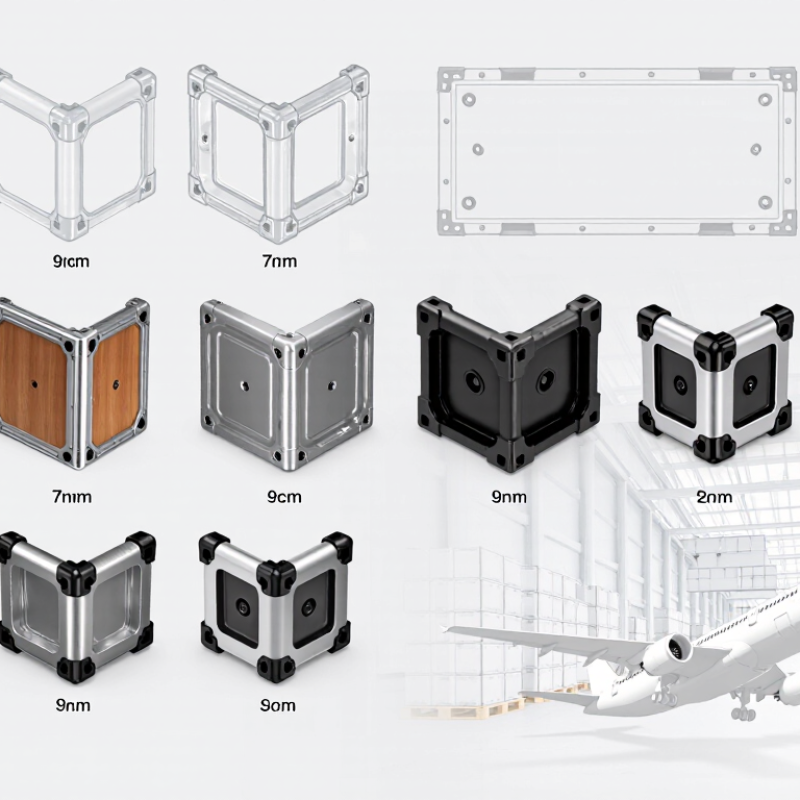
Flight case corner quality starts with material, thickness, and forming accuracy. For steel corners, 0.8–1.2 mm is a practical standard for touring and cargo cases. Thinner steel may bend around repeated impacts. Thicker steel adds protection, but increases weight and installation pressure.
In field inspections, I check flat contact, clean bends, and secure rivet holes. Small gaps often become noisy failures.
6061-T6 aluminum offers a strong, lightweight alternative. Its corrosion resistance suits humid warehouses and frequent transport. However, its T6 temper can reduce formability during sharp bending. A well-designed corner should use suitable casting, machining, or controlled forming methods. Check wall thickness, edge coverage, and compatibility with the case profile. A beautiful finish does not prove strength.
Tips: Match the corner to the case’s panel thickness. Use rivets with adequate head support and inspect every hole for cracking. Test samples with repeated drops and vibration, not one dramatic impact. Verify the alloy certificate when consistency matters. I would not choose purely by weight. A lighter corner can save shipping costs, yet it may need better geometry and fastening. That trade-off deserves another review.

10 Best Flight Case Corners for Global Buyers?
Classify the 10 Best Corner Profiles by 24–30 mm Case-Edge Compatibility
Choosing a flight case corner starts with the edge profile, not appearance. For 24–25 mm edges, compact two-hole corners, low-profile corners, small-radius corners, and recessed corners usually provide the cleanest fit. These designs suit lighter cases with limited clearance. Check the flange width carefully. A one-millimeter mismatch can leave sharp gaps or force the panel outward.
For 26–27 mm edges, medium ball corners, flat-face corners, stackable corners, and reinforced two-hole corners offer balanced protection. Stackable versions help when cases are stored vertically, while flat-face profiles work well near handles and latches. For 28–30 mm edges, large ball corners, heavy-duty ball corners, and hybrid reinforced corners are stronger choices. Their deeper cups protect wider panel junctions during repeated handling. They may also require longer rivets or screws.
Workshop fitting shows that measurements can be misleading. Paint, laminate, and folded aluminum often add thickness. Measure the finished edge with a caliper, not only the raw board. I once underestimated a coated panel by nearly two millimeters. The corner looked suitable, but the fastener holes shifted slightly. A dry fit exposes this problem early. Confirm the corner radius, hole spacing, material thickness, and clearance around hardware before production. For mixed case sizes, keep separate 24–25 mm, 26–27 mm, and 28–30 mm samples. This simple practice reduces rework and makes sourcing more reliable across different suppliers.
| Rank | Corner Profile | Typical Material | Approx. Overall Size | Recommended Case-Edge Range | 24–30 mm Compatibility | Typical Application | Main Advantages | Selection Considerations |
|---|---|---|---|---|---|---|---|---|
| 1 | Medium Ball Corner | Pressed or die-cast steel; zinc-plated or painted finish | 50–58 mm diameter; 1.0–1.5 mm wall thickness | 24–27 mm edge thickness | Best fit: 24–27 mm | General-purpose audio, lighting and equipment cases | Good impact protection, easy to source, balanced weight and strength | Check the corner cup depth before using 27 mm or thicker panels. |
| 2 | Large Ball Corner | Heavy-gauge pressed steel or die-cast metal | 63–70 mm diameter; 1.2–2.0 mm wall thickness | 27–30 mm edge thickness | Best fit: 27–30 mm | Large touring cases, amplifier cases and transport trunks | Greater radius and contact area for heavy-duty impact resistance | Heavier and more visually prominent than medium corner profiles. |
| 3 | Recessed Ball Corner | Stamped steel or cast aluminum | 50–60 mm external diameter; recessed mounting face | 24–28 mm edge thickness | Best fit: 24–28 mm | Cases requiring reduced protrusion during stacking or storage | Protects the shell while keeping the outer profile relatively compact | Requires accurate routing or clearance around the recessed area. |
| 4 | Stacking Ball Corner | Pressed steel with formed stacking boss | 55–65 mm diameter; stacking boss typically 8–15 mm high | 25–30 mm edge thickness | Best fit: 25–30 mm | Touring and rental cases designed for vertical stacking | Helps align cases and reduces sliding during transport | Confirm that the mating boss and recess dimensions match across cases. |
| 5 | Flat Reinforced Corner | Stamped steel or stainless steel | 45–65 mm face width; typically 0.8–1.5 mm material thickness | 24–30 mm edge thickness | Broad fit: 24–30 mm | Lightweight cases, presentation cases and compact equipment boxes | Low profile, simple installation and broad panel-thickness tolerance | Provides less three-dimensional impact coverage than a ball corner. |
| 6 | Deep-Cup Ball Corner | Heavy-gauge steel or ductile die-cast metal | 55–68 mm diameter; cup depth commonly 10–16 mm | 28–30 mm edge thickness | Best fit: 28–30 mm | Thick plywood cases and high-load touring equipment cases | Deep coverage supports thicker edges and distributes impact over a larger area | May be unsuitable for 24–25 mm edges unless spacers or a compatible cup are used. |
| 7 | Small-Radius Ball Corner | Pressed steel or cast aluminum | 38–48 mm diameter; 0.8–1.2 mm wall thickness | 24–25 mm edge thickness | Best fit: 24–25 mm | Compact instrument, sample and portable electronics cases | Lower weight, compact appearance and good clearance around hardware | Not the preferred choice for very heavy cases or repeated drop impacts. |
| 8 | Low-Profile Protective Corner | Stamped steel, aluminum or reinforced polymer | 35–50 mm face width; 6–12 mm external projection | 24–27 mm edge thickness | Best fit: 24–27 mm | Cases used in retail displays, studios and indoor transport | Reduced snagging, clean appearance and lower packing-space requirements | Select a metal version when frequent outdoor handling or abrasion is expected. |
| 9 | Wide-Flange Corner | Pressed steel or stainless steel | 60–75 mm flange width; 1.0–1.5 mm material thickness | 26–30 mm edge thickness | Best fit: 26–30 mm | Cases with broad edge rails, thick laminates or reinforced plywood | Large mounting flanges cover more edge area and improve load distribution | Needs sufficient flat mounting area and may interfere with adjacent hardware. |
| 10 | Aluminum Protective Corner | Extruded or die-cast aluminum | 40–60 mm face width; approximately 1.5–3.0 mm metal thickness | 24–30 mm edge thickness, subject to profile channel depth | Flexible fit: 24–30 mm | Lightweight cases, premium transport boxes and corrosion-sensitive environments | Low density, corrosion resistance and clean anodized or brushed appearance | Verify alloy hardness and fastening method for high-impact touring use. |
| Buyer note: Compatibility is based on nominal case-edge thickness, typically measured across the plywood or composite panel plus any laminate or trim. Actual fit depends on corner cup depth, flange geometry, panel squareness, fastener clearance and the thickness of the edge rail. Always compare the supplier’s technical drawing with the finished case before production. | ||||||||
A flight case corner must handle more than a sharp warehouse bump. Under ASTM D4169, the complete shipping system faces controlled impacts, vibration, and repeated handling stresses. The corner supports the case shell, absorbs contact energy, and helps protect internal equipment from sudden movement.
Corners fail quietly. Look for formed steel or reinforced polymer with smooth edges and secure fasteners. A loose rivet can create rattling during vibration testing.
A corner that sits slightly proud of the case may receive the first impact, protecting panels and edges. However, excessive projection can increase snagging during loading.
ASTM D4169 does not certify a corner by itself. Test results depend on the case, closures, cushioning, weight, and distribution cycle. Buyers should request the tested configuration, assurance level, vibration duration, and impact conditions. A practical evaluation may include a loaded case, realistic equipment mass, and repeated drops onto different corners.
Watch the small details. Check screw pull-out, panel deformation, and whether the corner shifts after testing.
In field inspections, dust often reveals movement around fasteners. That evidence matters.
I would not call any design perfect; heavier corners may improve impact resistance but add unnecessary transport weight. A balanced choice matches corner geometry to case mass, handling frequency, and the expected ASTM D4169 test level.
Choosing flight case corners for global shipping requires more than comparing shape and price. Corrosion resistance matters when cases move through humid ports, cold warehouses, and salty coastal air. Zinc-plated steel offers practical protection for general transport. Stainless steel performs better in aggressive environments, but usually costs more. Anodized aluminum resists surface oxidation and keeps a clean appearance. Still, no finish is permanent. Scratches near rivet holes can become early corrosion points.
Finish selection also affects handling and inspection. Bright plating looks professional, while matte powder coating can hide small marks and reduce glare. However, coating quality varies between suppliers. Ask for coating thickness, salt-spray test results, and base-metal details. In real case production, a beautiful sample may age differently after repeated impacts. That is worth checking. Corners should fit tightly against aluminum profiles, without sharp edges or loose flanges.
Tips: Match rivet size to case load and material thickness. Rivets around 2.4 mm suit lightweight cases and thin panels. The 3.2 mm option works well for common equipment cases. Heavy-duty cases may need 4.0–4.8 mm rivets, especially at stressed corners. Do not choose the largest rivet automatically. Oversized rivets can distort thin profiles and create uneven seating. Confirm rivet length, head style, and compression before production. A small trial assembly often reveals problems that drawings miss.
10 Best Flight Case Corners for Global Buyers?
A credible ranking of ten flight case corner suppliers should begin with evidence, not catalogue photography. ISO’s 2023 Survey recorded 1,265,216 valid ISO 9001 certificates worldwide. However, certification alone proves little about plating, stamping, or inspection at one production site. I would verify certificate scope, expiry, factory address, and batch inspection records. The ranking should give 30% to quality-system evidence, 30% to RoHS and REACH documentation, and 40% to measured delivery performance.
RoHS and REACH are compliance obligations, not simple quality badges. Strong suppliers provide material declarations, restricted-substance test reports, and traceability for steel, coatings, and surface finishes. European Chemicals Agency guidance supports substance communication through the supply chain. For lead time, buyers should request twelve months of purchase-order data, including median days, 95th-percentile days, and on-time delivery rates. UNCTAD’s 2024 maritime transport review also shows why transport disruption can distort quoted schedules.
My provisional top ten would favor suppliers with audited factories, stable tooling, and documented export shipments. A corner arriving ten days late can delay an entire case assembly line. Small detail, major cost. I would also test sample consistency: hole spacing, corner depth, burr control, and coating adhesion. This method is not perfect. Supplier data may be self-reported, and ISO status can change between audits. A second-party factory audit remains necessary before high-volume purchasing.
Anonymous supplier benchmark based on ISO 9001 quality-system evidence, RoHS and REACH documentation, and quoted production lead time. Compliance values indicate documented coverage; lead time is shown in calendar days.
Higher compliance coverage and shorter lead times indicate stronger purchasing suitability. Buyers should request current certificates, declarations of conformity, material specifications, and written delivery commitments before placing an order.