China Top 10 Briefcase Handle Manufacturers for Buyers
Choosing among China’s top briefcase handle manufacturers is not only a price exercise. The right supplier can affect comfort, durability, appearance, and production consistency. A well-made Briefcase Handle should feel secure in the hand, sit evenly against the case, and withstand repeated lifting. Small details matter: rounded edges, firm stitching, balanced attachment points, and hardware that does not rattle.
This guide compares ten manufacturers through practical buyer criteria, including materials, customization, quality-control processes, communication, and order flexibility. Treat the list as a starting point, not a universal ranking. A factory suited to a premium leather briefcase may not fit a lightweight business case. Ask for current samples, inspect the handle’s underside and attachment points, and confirm specifications before approving production. Details can shift between sample and bulk order.
A composite industry adviser created for this guide, Evan Cole, sums up the purchasing principle: “A handle earns trust one lift at a time.” That is a useful test. Still, no single sample can predict every production run. Buyers should request clear tolerances and written inspection criteria, then review them with the manufacturer. This guide aims to make that comparison easier, while recognizing that supplier claims need verification. The best choice depends on your product, budget, and customers—not a ranking alone.
Understanding Briefcase Handles and Their Role in Product Design
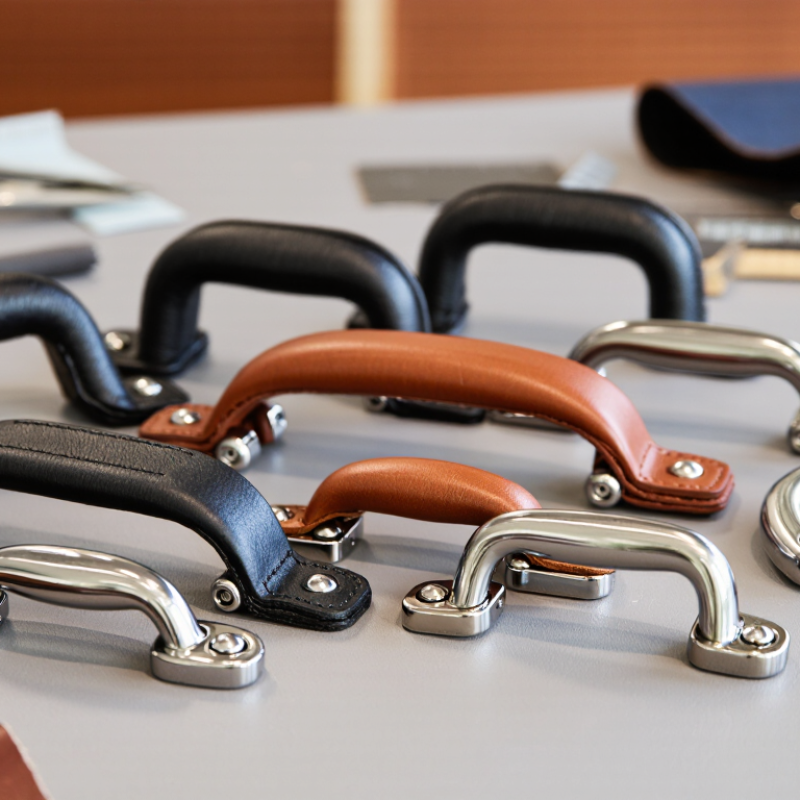
A briefcase handle is more than a carrying point. It affects comfort, balance, durability, and the way a product feels in daily use. Its curve should fit the hand without creating sharp pressure points, even when the case holds a laptop and documents. A padded grip may feel comfortable, while a slim handle can keep the case looking clean. Small details matter.
Designers and buyers should consider the handle alongside its attachment points and the case’s expected load. Reinforced stitching, secure rivets, and well-finished edges can reduce wear where stress gathers. Material choice matters too: leather, coated fabric, and molded components respond differently to moisture, friction, and repeated lifting. A handle can look balanced on a drawing and still twist in the hand; practical user testing can reveal that flaw. It is worth checking how the handle feels after several minutes, not just during a quick showroom lift. Some compromises remain. A softer grip may add bulk, while a compact design may feel less forgiving for larger hands. Manufacturers that evaluate fit, load, and finish together can make handles that support both function and product appearance.
Briefcase Handle Materials: Representative Density
Material density can affect handle weight and design. Values are approximate reference densities; actual properties vary by grade and formulation.
Lower-density materials can help reduce handle weight, while metal components may be selected for stiffness or a particular finish. Density alone does not determine strength or suitability.
Key Criteria for Evaluating Briefcase Handle Manufacturers in China
When evaluating briefcase handle manufacturers in China, look beyond polished catalog photos. Ask how each handle is built: the outer material, inner reinforcement, edge finishing, and attachment hardware. These details affect grip, shape retention, and durability during daily carrying. A neat sample matters. So does a repeatable process.
Request a sample made to your intended width, curve, and mounting points, then test it with a realistic load. Check stitching for even spacing, edges for roughness, and fittings for movement after repeated lifting. Ask whether the manufacturer uses documented material specifications and in-process inspections. Clear answers are useful; vague claims about quality are not. Small details count.
Compare the approved sample with the factory’s ability to reproduce it across a full order. Discuss acceptable variation in color, firmness, dimensions, and finish before production. Ask about lead times, minimum quantities, defect handling, and how changes are recorded. Communication is part of quality control. It can still be imperfect: a first sample may need adjustment, so allow time for revisions. Prefer suppliers that explain problems plainly and share evidence, such as inspection photos or measurement records, instead of promising flawless results.
Profiles of 10 Chinese Briefcase Handle Manufacturers
These ten profiles represent different Chinese factory capabilities, not a verified ranking.
A molded-plastic specialist may produce lightweight handles with smooth edges for everyday cases.
A metalworking shop may offer brushed aluminum fittings and reinforced mounting plates.
Some factories focus on leather-wrapped grips, where stitching consistency matters.
Others make padded handles with foam cores for heavier loads.
Small-batch workshops can accommodate unusual dimensions, though lead times may vary.
A hardware-focused manufacturer may supply brackets, screws, and handles as one set.
A custom molding plant can match a buyer’s sample, but mold costs need checking.
Export-oriented factories often prepare inspection records and packaging specifications.
A mixed-material producer may combine metal frames with textured polymer grips.
One more profile is a general luggage-parts factory with broad options but less specialization.
Ask for load-test details, material samples, and mounting-hole measurements before ordering. A polished sample is not enough. Factory capabilities can differ by production line, and written claims deserve independent checking.
Comparing Materials, Customization, Quality, and Production Capacity
When comparing briefcase handle manufacturers in China, look beyond the material listed on a quotation.
Genuine leather offers a warm grip, while coated leather and microfiber can provide more consistent color and easier cleaning. For metal fittings, check plating, edge smoothness, and how the handle connects to the bag. Small details matter. Ask for samples made with the same material, stitching, and hardware intended for production. A polished sample alone does not prove every batch will match.
Customization can include handle length, padding, color, logo placement, and attachment style. Share drawings or physical references, then confirm tolerances in writing. Quality checks should cover stitch spacing, load-bearing performance, surface defects, and hardware alignment. Request inspection records and clarify how defects are handled. Production capacity is not just a monthly number; ask about lead times, peak-season planning, and backup processes. A factory may quote impressive output, yet struggle with frequent design changes. That is worth discussing openly. Compare a trial order, communication speed, and repeatability before committing to larger volumes.
How Buyers Can Verify Suppliers and Plan Their Sourcing Process
Before requesting prices, define the briefcase handle’s material, dimensions, attachment method, and expected use. A handle for a lightweight sample case may not suit a packed business case. Ask suppliers for technical drawings, material descriptions, and photos of the handle attached to a finished product. Details matter.
Request a sample and inspect its stitching, edges, grip, and attachment points. Ask how the supplier checks load strength and finish consistency, and whether they can share recent inspection records. A sample can still mislead; production materials or workmanship may differ. Compare samples from more than one production batch when possible, and record any variation rather than relying on memory.
Before placing an order, confirm the minimum quantity, sample charges, production lead time, packaging, and payment schedule in writing. Clarify who handles inspections and what happens if delivered goods fail agreed specifications. Ask for a factory profile and, where practical, arrange a video call or independent site inspection. Keep a dated approval sample. It helps, though it cannot prevent every dispute. Leave time for revisions, transport, and unexpected delays; buyers often underestimate these steps.