Leave Your Message
Choosing the right Corner Protector supplier can shape product safety, packing efficiency, and customer satisfaction across international markets. A reliable supplier should offer stable dimensions, clean edges, suitable materials, and consistent production quality. These details matter when cartons face vibration, stacking pressure, moisture, or repeated handling.
This guide reviews ten Corner Protector suppliers for global buyers. It focuses on manufacturing experience, material options, customization, quality control, packaging capacity, and communication. Some suppliers may excel in heavy-duty plastic protection, while others may specialize in foam, cardboard, rubber, or reusable designs. Buyers should compare samples before placing large orders. A product that looks strong may still crack during cold storage or slip on smooth surfaces.
Small details matter.
Supplier evaluation also requires practical evidence. Ask for production photos, inspection records, material specifications, and clear tolerance information. Confirm whether the supplier can support private labeling, export packaging, and dependable lead times. Certifications can strengthen confidence, but they should be checked rather than accepted without review.
No supplier is perfect.
A lower price may hide thinner material, weaker adhesive, or inconsistent sizing. Communication may also become difficult across time zones and languages. For this reason, global buyers should assess responsiveness, problem-solving habits, and after-sales support. This introduction provides a practical starting point, not a final purchasing decision. Actual performance depends on the product design, shipping route, handling conditions, and order requirements. Careful testing remains essential.
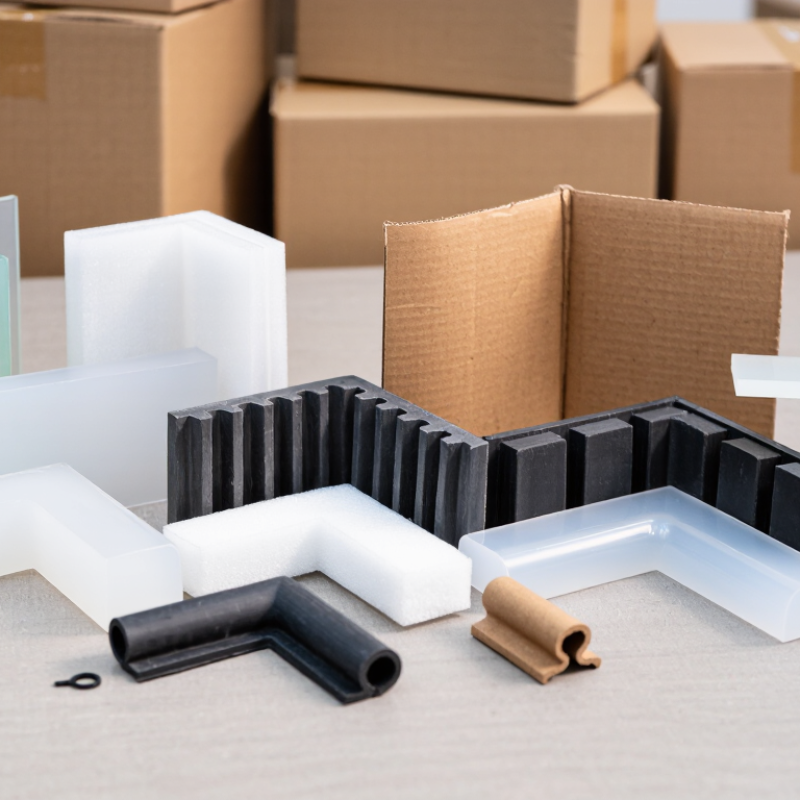
Corner protectors look simple, but their profile determines how well they shield an edge. L-shaped paperboard guards suit carton corners and help distribute strapping pressure. Plastic profiles resist moisture and repeated handling, while foam guards cushion polished or fragile surfaces. For heavy loads, thicker walls and longer legs can spread force across a wider area. The right choice depends on the product, load, and shipping route—not just price.
Packaging data helps explain why material selection matters. The U.S. Environmental Protection Agency’s 2018 Facts and Figures report recorded 41.9 million tons of paper and paperboard packaging generated, with about 32.1 million tons recycled. Paperboard protectors can fit into established recycling streams where local collection accepts them. Yet a recyclable material is not automatically the best protection. A crushed corner can mean damaged goods and extra packaging. Small detail, big consequence.
Profiles also affect packing speed and stability. Equal-leg angles fit standard carton corners; unequal-leg designs can protect one exposed face more deeply. U-shaped guards cover panel edges, while flat strips reinforce stacked layers. Specify length, wall thickness, moisture exposure, and compression needs before ordering. Packaging tests should reflect real pallet loads and transit conditions. And yes, the first sample may fail. That is useful evidence, not a reason to guess.
Supplier categories below describe common sourcing options rather than named companies. Product dimensions, strength, and suitability vary by design and should be confirmed with samples and specifications.
| Supplier Type | Common Material | Typical Profile | Packaging Function | Best-Fit Applications | What Buyers Should Verify |
|---|---|---|---|---|---|
| Paperboard angle-board manufacturers | Layered kraft paperboard | Rigid L-shaped angle, supplied in cut lengths | Reinforces pallet corners and helps distribute strap tension | Cartons, palletized goods, furniture, and appliances | Leg length, wall thickness, moisture resistance, compression performance, and recycled content |
| Custom paper angle-board converters | Kraft paperboard, sometimes with a moisture-resistant treatment | Cut-to-length L profiles, including notched or slotted options | Fits package dimensions and supports edge protection during unitization | Irregular loads and customer-specific pallet patterns | Tolerance, notch placement, lead time, minimum order quantity, and packaging for transit |
| Recycled-plastic profile manufacturers | Reprocessed thermoplastics, depending on the product design | Extruded or molded L-shaped profiles | Reusable edge protection for handling and storage | Returnable transport systems and repeated warehouse use | Resin type, temperature range, impact behavior, recycled-content documentation, and end-of-life options |
| Rigid PVC profile suppliers | Rigid polyvinyl chloride (PVC) | Extruded L, U, or channel profiles | Shields exposed edges from scuffing and light impact | Panels, glass-related components, and finished goods needing a clean edge | Material grade, dimensional tolerances, temperature limits, and applicable chemical or environmental requirements |
| Polyethylene foam fabricators | Expanded polyethylene (EPE) foam | L-shaped foam sections or fitted corner blocks | Cushions corners and helps limit abrasion during transit | Appliances, electronics, furniture, and other impact-sensitive products | Foam density, dimensions, compression recovery, cleanliness, and fit with the outer carton |
| Polyurethane foam converters | Flexible or semi-rigid polyurethane foam | Die-cut corner pads, blocks, or custom contours | Provides cushioning and helps prevent movement inside a package | Fragile or shaped items requiring tailored cushioning | Foam firmness, compression behavior, fit, dust control, and any product-specific safety requirements |
| Molded-pulp packaging suppliers | Molded recycled paper fiber | Formed corner caps, trays, or end supports | Holds products in position and absorbs some handling shock | Consumer goods, electronics, and products packed in fitted inserts | Tooling cost, fit, moisture sensitivity, stackability, and recycled-fiber specifications |
| Corrugated packaging converters | Corrugated fiberboard | Folded corner posts, pads, and multi-layer inserts | Combines edge protection with carton or pallet-load reinforcement | Shipments where recyclable paper-based packaging is preferred | Board grade, flute construction, stacking requirements, humidity exposure, and assembly method |
| Injection-molded protector suppliers | Thermoplastics such as polypropylene or polyethylene, depending on design | Reusable corner caps or molded corner blocks | Protects corners and may attach to products or straps, depending on design | Repeated shipping cycles, reusable packaging, and standardized product corners | Tooling investment, resin specification, attachment method, fit, and durability testing |
| Integrated packaging-system providers | Paperboard, foam, molded fiber, plastics, or combined materials | Application-specific corners designed with cartons, dividers, or cushioning | Coordinates corner protection with the full package and unit load | Complex products, export packaging, and multi-component packaging projects | Testing scope, design ownership, documentation, production capacity, and compatibility with packing lines |
Buyer note: Compare samples under the intended load, stacking, strapping, storage, and transport conditions. No single material or profile is suitable for every shipment.